If you’ve never used a breast pump before and don’t
have clue about how to choose one, then this is the place to be.
We’ve compiled all the information that you need to know
about breast pumps so that you can make an informed decision when
you choose one.
When you are trying to choose a breast pump, remember it is an
essential item that will ensure the health and well-being of your
child. Even the most expensive breast pumps are more affordable
than the cost of formula feeding for a year.
The goal is to select a pump that will very closely mimic your
baby’s suckling. The more similar your pump is to your baby
the more comfortable pumping will be for you and the more successful
you will be at expressing milk.
Main Criteria on Which Pumps Are Judged
Effectiveness – A pump’s effectiveness
is generally based on how often the pump cycles. A nursing baby
sucks approximately 45 to 55 times each minute. The closer a pump
is to this range the more effective it will be at drawing milk
from the breast.
Pumps with cycling rates lower than 25 are likely to be ineffective
at expressing milk. When a pump has a cycling rate this low the
cycles tend to be longer and can cause nipple and breast pain
since they are suctioned and pulled for long stretches of time.
Auto-cycling pumps tend to be more effective than pumps that require
the user to manually adjust cycling during a pumping session.
A pump’s suction or vacuum strength will also determine
its effectiveness. The average suction strength of the breast
pumps available today range from 0 mm Hg to 250 mm Hg. A pump
with a vacuum above 250 mm Hg could cause severe pain.
Durability – Not all breast pumps are
created equally. Some have durable motors that are designed for
frequent, daily pumping while others have smaller motors, which
are only recommended for occasional pumping. Because of these
differences in durability, how often you plan to pump is an important
factor when it comes to choosing your pump.
If you use a pump more often than its recommended purpose, you
may wear out the motor prematurely and shorten the pump’s
lifespan.
Type of Pumping – There are three types
of pumping actions including single, double alternating and double
simultaneous.
Single pumps allow you to pump one breast at a time and are appropriate
for occasional pumping. Occasional pumping refers to pumping once
a day. This type of pump is usually suitable for a stay-at-home
mom or a mom who works part-time.
Double alternating pumps stimulate both breasts but at alternating
times. When suction is created on one side, it is released on
the other. While alternating pumping offer more stimulation than
single pumping, these pumps are still not as efficient at pumping
as double simultaneous pumps.
Double simultaneous pumps stimulate both breasts at the same
time, and offer the most superior pumping available. When using
a double simultaneous pump, most moms are able to cut their overall
pumping time in half and increase their milk production.
Comfort Level – The breast shields that
are used with a pump will have an affect on how comfortable it
is to use. Some pumps come with an included one-size fits all
type of breast shield, which can be uncomfortable for moms with
larger breasts and/or nipples and can hinder their milk output.
A pump’s cycling also affects its comfort level. Auto-cycling
pumps are usually more comfortable for pumping moms as well since
manual cycling often results in the suction lasting too long.
Motor Noise Level – Although the noise
level of the pump motor may not be the most important aspect of
the pump, it may be a feature that you are concerned about especially
if discretion is important to you. For some mothers, a noisy pump
motor can be a distraction while pumping.
In general, larger motors tend to be quieter while smaller motors
are louder.
Power Options – While an AC adapter is
often the most reliable power source, it may not be the most convenient
option in all situations. When choosing a pump, consider where
you will be pumping. Will there be times when an electrical outlet
is not available? Do you travel often? If so, then you may need
to choose a pump that offers a car adapter and/or the ability
to run your pump on batteries as alternatives.
Portability –The portability of the pump
can be a major factor in your decision if you will be pumping
often since you will need to take the pump with you wherever you
are going. The pump’s portability can be determined by the
weight, power options and carry bag option.
Cleaning and Safety Concerns Regarding Breast Pumps
Daily cleaning – Thoroughly cleaning your
breast pump’s washable parts after use is an important step
in keeping your baby healthy. All parts that are exposed to breastmilk
or your breast should be washed in hot soapy water, rinsed and
air-dried after each use.
Sterilizing – Most breast pump manufacturers
recommend sterilizing all the washable parts of your breast pump
once a day. There are several sterilization methods available
including boiling parts on the stove, sterilizing in a dishwasher
that reaches 140 degrees, using a microwave sterilizer or an electric
sterilizer.
Used breast pumps – Borrowing or buying
a used breast pump is not recommended because breast pumps are
considered personal hygiene items. Several potential health risks
associated with using a previously used breast pump. Some of these
risks include the presence of cytomegalovirus (CMV), hepatitis,
human immunodeficiency virus (HIV), human T-cell leukemia virus
type 1 (HTLV-1) or other viruses on the pump parts that were exposed
to the previous mother’s breastmilk.
If you are considering borrowing or buying a used breast pump,
you should be aware that not all pump parts can be washed and
sterilized. The best way to avoid these potential risks is to
only use a new, unused personal breast pump. Although personal
use breast pumps are not safe to share, hospital grade rental
pumps are approved for multiple users as long as each mother uses
her own collection kit.
How Do the Major Pump Brands Measure Up to One Another?
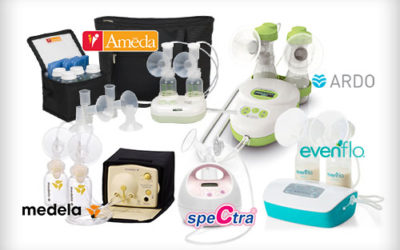
Best Pumps – The top rated breast pump
brands include Ameda, Avent and Medela. These pump brands receive
the most satisfactory customer reviews across the board.
Ameda
breast pumps have been a trusted name in hospitals and with
lactation consultants for more than 50 years. The Ameda was
the first manufacturer to introduce a closed collection system
to consumers. The patented HygieniKit is the only collection
system approved by the FDA to preserve the purity of expressed
milk.
Avent
is one of the most popular infant feeding brands in the country.
For over 10 years, Avent has had the most popular manual breast
pump, the Isis. The popularity of the Isis led Avent to develop
the Isis iQ series of electric breast pumps.
Medela
has been a major manufacturer of breast pumps in the U.S. for
more than 20 years. While Medela has built up their reputation
with hospitals and lactation consultants, their popularity with
consumers has begun to dwindle since they have failed to adopt
closed system collection for their pumps and have restricted
online retailers from selling them below retail prices.
Worst Pumps – Evenflo,
Gerber
and First
Years are amongst the brands of pumps with the poorest customer
reviews. These pumps often fall short of customers’ needs
and expectations – express milk inefficiently and often
cause nipple pain. Pumps from these brands tend to be the cheapest
options available, and they have less than adequate manufacturer’s
warranties.
Other Available Pumps – Dr. Brown’s,
Lansinoh, Playtex and Whisper Wear are lesser-known breast pump
brands on the market.
Dr.
Brown’s is a popular manufacturer of infant
feeding bottles, which are designed to mimic breastfeeding.
The Dr. Brown’s Natural Flow breast pumps were introduced
in 2006. The pumps use pulsating massage and nipple compression
to give mothers a pumping experience that feels more comfortable
and natural.
Lansinoh
was founded by a breastfeeding mother more than 20 years ago
to provide other breastfeeding mothers with pure lanolin. Since
then Lansinoh has begun to offer other breastfeeding products
including a double electric breast pump (which is very similar
to the Ameda Purely Yours) and a manual breast pump.
Playtex
has manufactured infant feeding products since 1960. Playtex
worked closely with Dr. William Sears M.D., well-known pediatric
specialist and author, to develop their line of breast pumps.
The Playtex breast pumps all use dual action massage and suction
to mimic a baby’s natural nursing more closely.
Whisper
Wear introduced the first hands free breast pump
to the market about 4 years ago. While the hands free concept
strives to provide moms with the utmost in convenience, the
pump design fails to perform efficiently.
Bailey
Medical is a lesser-known pump brand that has been
on the market for the past 20 years. Bailey Medical offers a
reasonably priced double electric pump, the Nurture III, which
has been approved safe for multiple users by the FDA.
Open System vs. Closed System – What’s the difference?
Recently there has been a lot of discussion over whether closed
system breast pumps are really better than open system breast
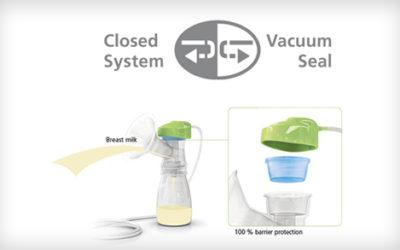
pumps. The basic difference between the two types of pump is that
closed system pumps have a diaphragm that separates the pump’s
tubing from the collection bottle and breast cup.
A closed system’s diaphragm acts as a barrier, which protects
expressed milk from outside air that is being drawn through the
pump’s tubes, and it prevents milk from leaking into the
tubing. Since this barrier is in place, closed system pumps are
considered more hygienic because expressed milk is never exposed
to the pump tubing or motor, and the tubing never requires washing
or sterilizing.
If you use an open system pump, there is no barrier in between
the tubes and milk collection so there is a chance that milk will
leak into the pump’s tubing. Most moms see this an more
of an inconvenience than anything since you have to then wash,
sterilize and air dry the tubes before pumping again. However,
some moms say small amounts of milk can get into the pump tubing
without you noticing because mold was found in their tubes, but
they had not had a milk leak.
If mold is in the tubes then you may have other problems because
that means the air going through the pump has been exposed to
the mold – the same air that is exposed to the pump motor
and your expressed milk. Most pump manufacturers are now switching
to a closed system design to prevent these potential problems.
Once you have determined which type of breast pump will be best
suited for your pumping needs, you can begin to compare the different
models that you are interested by looking at the Breast
Pump Specs that we have compiled and read
Breast Pump Reviews written by other pumping moms.